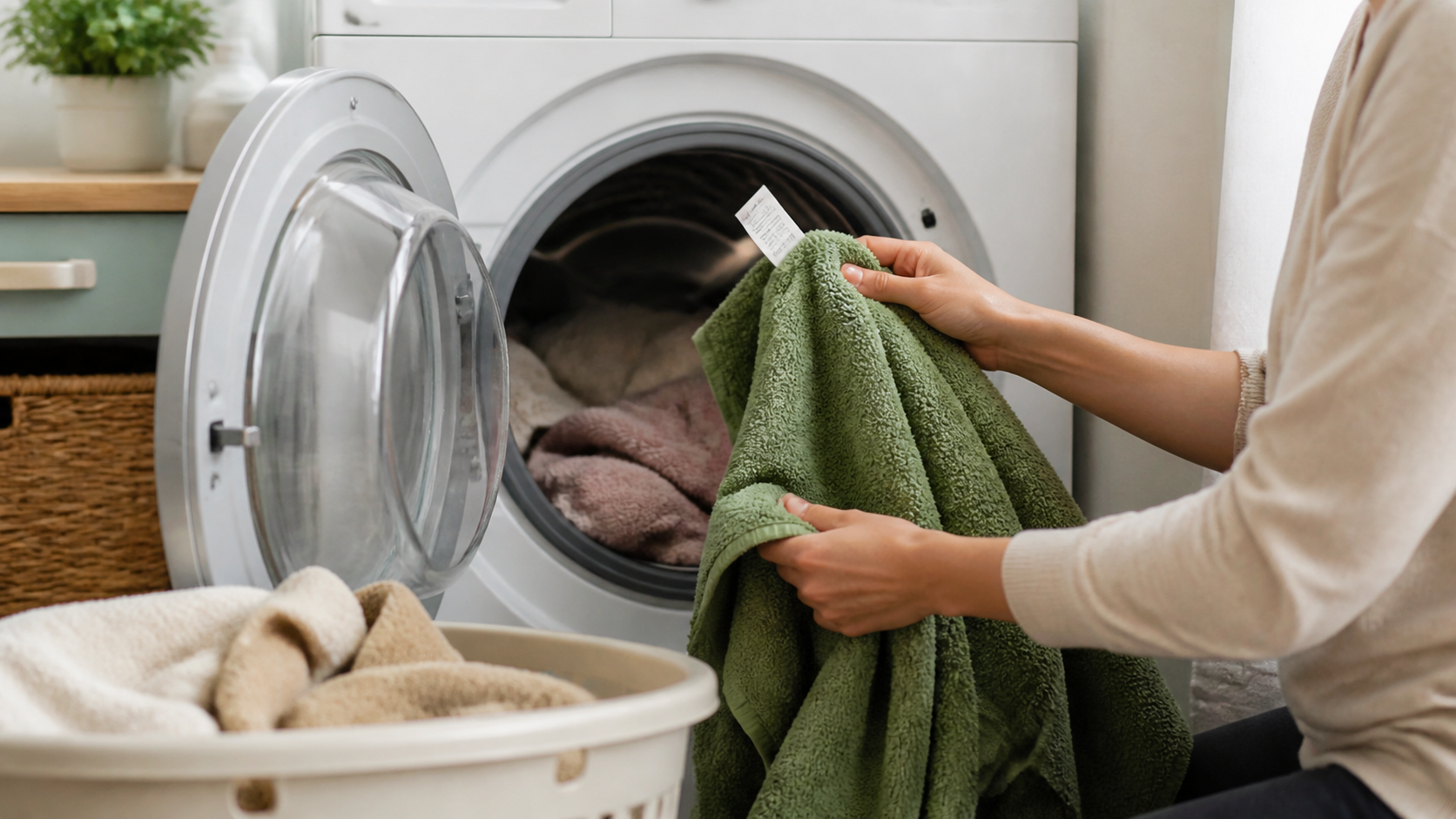
Soft, absorbent towels depend less on adding a “softening” product and more on preventing residue, giving the load room to rinse, and drying it completely without excessive heat. Start with the towel’s care label, use a measured amount of detergent, avoid overloading the washer, and limit products that coat the fibers.
Why towels become stiff or less absorbent
Too much detergent can remain in dense towel loops, especially when the washer is tightly packed or the rinse is inadequate. Fabric softener and some dryer-sheet ingredients can leave a coating that makes towels feel smooth at first but reduces the absorbency people expect from them. Mineral-heavy water, air-drying without movement, and repeated over-drying can also affect how a towel feels.
New towels may shed lint for several washes. That is different from stiffness and does not necessarily mean the washing method has failed.
A reliable towel-washing method
- Check the care label and separate light and dark colors as needed.
- Keep towels away from garments that attract lint or contain zippers and hooks that can snag loops.
- Load the washer loosely enough for the towels to move and rinse.
- Measure detergent according to its label, your machine, load size, water conditions, and soil level. Do not add extra “for softness.”
- Select the care-label-approved cycle and water temperature.
- Use an extra rinse if you have a specific reason to suspect residue and the machine offers that option.
- Dry towels completely, remove them when dry, and fold only after trapped moisture has escaped.
This approach avoids universal temperature or dosage rules. Cotton, bamboo-derived rayon, microfiber, decorative towels, and blended fabrics do not all tolerate the same heat or cycle.
Be cautious with fabric softener and dryer sheets
If maximum absorbency is the goal, skip routine fabric softener and dryer sheets unless the towel maker says otherwise. Whirlpool’s care guidance notes that softening ingredients can coat towel fibers and reduce absorbency. If you choose to use a compatible softener, follow its label exactly and do not pour it directly onto dry fabric.
Avoid internet “laundry stripping” mixtures and improvised combinations of bleach, acids, ammonia, or other cleaners. Laundry products should not be mixed unless a product label explicitly instructs that combination. If towels need sanitizing because of a specific contamination concern, use a fabric-safe method supported by the towel, laundry-product, and machine instructions.
Dry for loft without baking the fibers
Shake towels out before transferring them to the dryer; separating the folds helps air move through the load. Use a care-label-approved setting and avoid running a long high-heat cycle after the towels are already dry. Dryer balls may help separate items mechanically, but they do not remove detergent residue and are not a substitute for correct loading.
Air-dried towels can feel firmer because they dry without tumbling. Shaking them before hanging and again when dry may loosen the loops. Make sure there is enough airflow for full drying, particularly indoors.
If clean towels still feel rough
First reduce the variables. Confirm the detergent dose, run a smaller load, and inspect whether the washer is rinsing and draining normally. Check the machine’s detergent dispenser and cleaning instructions if residue appears on more than towels. If hard water is suspected, follow detergent and washer guidance designed for your local water conditions rather than adding an unverified chemical remedy.
A persistent musty odor can point to incomplete drying or a washer that needs maintenance, not just to the detergent choice. Clean the washer as its manufacturer directs, dry towels promptly after washing, and leave no damp load sitting in the drum.
Keep towels soft between wash days
Hang each towel fully open after use instead of folding it over a hook or leaving it in a pile. The American Cleaning Institute recommends letting bath towels dry between uses and washing them after roughly three to five normal uses. Wash sooner if a towel is visibly dirty, remains damp, develops an odor, or is used during illness.
The useful rule is simple: remove soil with the correct detergent dose, rinse it away, and dry the towel fully. Adding more product rarely fixes a process that is leaving residue behind.
Sources
- American Cleaning Institute: Laundry Basics
- American Cleaning Institute: Do I Need to Wash This?
- Whirlpool: How to Wash and Dry Towels to Keep Them Soft
- Poison Control: Cleaning Product Safety